Physical Address
304 North Cardinal St.
Dorchester Center, MA 02124
Physical Address
304 North Cardinal St.
Dorchester Center, MA 02124


In a world of constant notifications, overflowing inboxes, and blurred boundaries between work and life, being busy is no longer the same as being effective. Personal efficiency, the ability to produce meaningful results with minimal wasted effort, has become one of the most valuable skills of the modern professional.
Unlike hustle culture myths that glorify exhaustion, true efficiency is rooted in science. Research from psychology, neuroscience, and behavioral economics shows that small, consistent habits dramatically outperform long hours and brute-force discipline. By optimizing how your brain manages energy, attention, and motivation, you can increase output without sacrificing health or creativity.
This article breaks down five science-backed habits that maximize output, explaining why they work, how to apply them, and how to sustain them long term. These are not productivity hacks, they are evidence-based systems for sustainable performance.
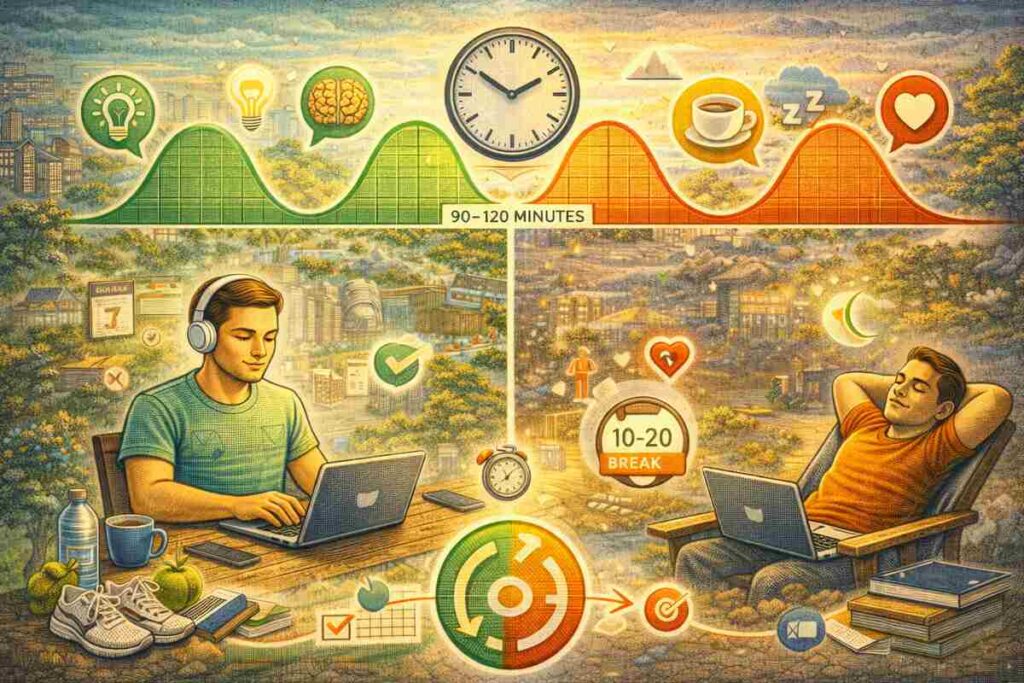
Most people plan their day around the clock. Highly efficient people plan around energy cycles.
Human performance follows ultradian rhythms, natural cycles of high and low energy that repeat every 90–120 minutes. Research summarized by the National Institutes of Health shows that cognitive focus, alertness, and problem-solving ability peak during these cycles and drop sharply afterward.
Ignoring these rhythms leads to mental fatigue, decision errors, and diminishing returns. Working with them increases output per hour.
How to apply this habit:
Companies that encourage cyclic work patterns report higher productivity and lower burnout, according to studies referenced by Harvard Business Review.
Efficiency is not about doing more hours, it’s about doing the right work when your brain is primed for it.
Your brain is not designed to store unlimited information, it is designed to solve problems. When you rely on memory to track tasks, deadlines, and ideas, you overload working memory and reduce efficiency.
Cognitive load theory, widely studied in educational psychology, shows that offloading information into external systems dramatically improves performance and learning. The concept is explained in depth by research published through Frontiers in Psychology.
Highly efficient individuals use trusted systems to capture, organize, and retrieve information so their mental energy remains available for execution.
Practical ways to externalize cognitive load:
David Allen’s Getting Things Done methodology popularized this idea, and its principles continue to be validated by modern neuroscience.
When your brain stops acting as storage, it becomes faster, calmer, and more creative.

Sleep is often framed as a recovery tool. In reality, it is a productivity amplifier.
Neuroscience research shows that sleep directly affects attention, memory consolidation, emotional regulation, and decision-making. According to data summarized by the Sleep Foundation, even mild sleep deprivation can reduce cognitive performance by up to 30%.
Elite performers, from athletes to CEOs, protect sleep aggressively because it compounds every other efficiency habit.
Why sleep boosts output:
Actionable sleep efficiency tips:
Chronic sleep deprivation creates the illusion of productivity while silently eroding output quality. Sustainable efficiency starts the night before.
Not all tasks are created equal. The Pareto Principle, commonly known as the 80/20 rule, states that roughly 80% of results come from 20% of efforts.
This principle has been validated across economics, business, and behavioral science. Analysis published by Investopedia explains how disproportionate outcomes consistently emerge in complex systems.
Highly efficient people obsess over identifying the small set of actions that drive the majority of meaningful results and they minimize everything else.
How to use 80/20 thinking daily:
Efficiency is not about clearing your to-do list, it’s about completing the tasks that actually move the needle.

Motivation is unreliable. Systems are not.
Behavioral science shows that habits form through repetition, environmental cues, and reward loops, not willpower. Research from James Clear’s behavioral science summaries and studies published in the European Journal of Social Psychology demonstrate that consistent systems outperform bursts of motivation.
Efficient individuals design their environment to make productive behaviors automatic.
Examples of system-based efficiency:
When habits run in the background, your output increases without increasing mental effort.
These five habits are powerful individually, but transformational when combined:
Together, they create a self-reinforcing loop of high output and low burnout.
Even with the right habits, efficiency collapses when people:
True efficiency is boring, repeatable, and sustainable.
Personal efficiency is not about squeezing more work into your day, it’s about designing your life so meaningful work flows naturally. Science consistently shows that small, intentional habits outperform extreme effort.
By aligning with your biology, reducing mental friction, and building systems instead of relying on motivation, you can maximize output while preserving energy, creativity, and well-being.
In the long run, efficiency is not just a productivity advantage, it’s a competitive edge.